AI vs Shopify?
AI vs Shopify: Is Platform Dominance Ending in 2025?

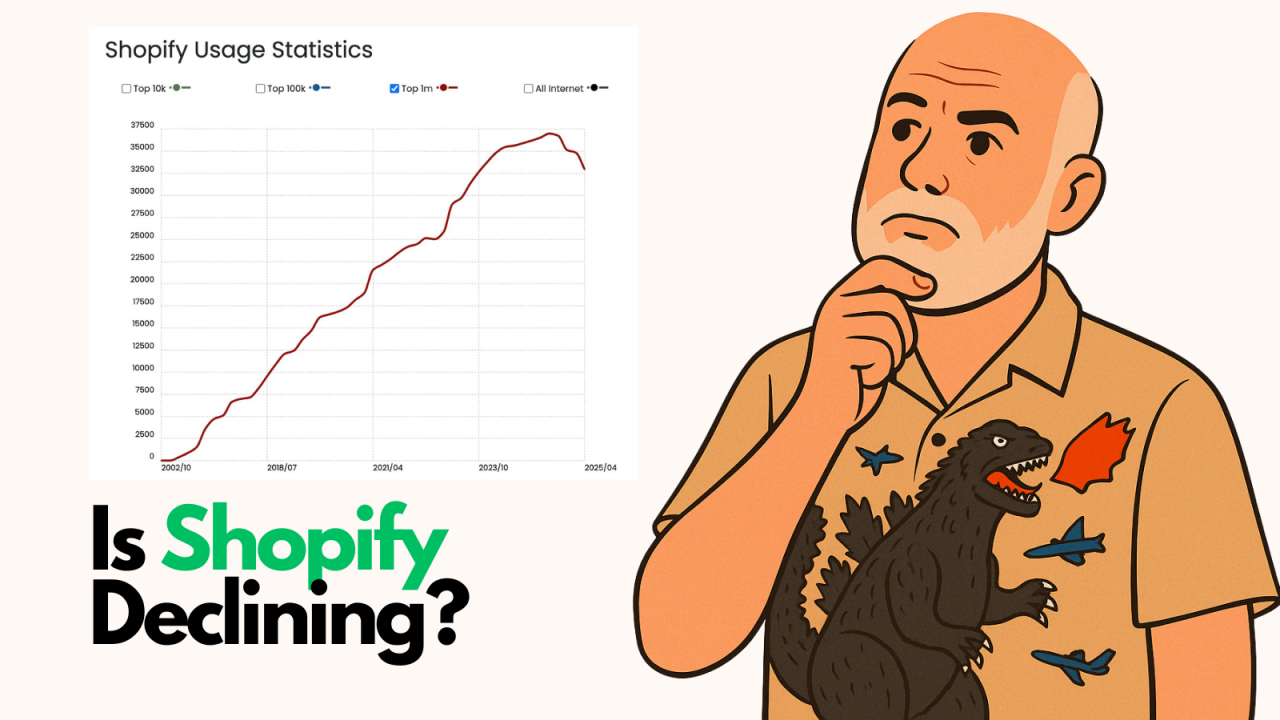
Nicklas Gellner from Medusa is talking about AI killing Shopify and he referenced this image from Builtwith (His post is here)

Please don’t get me wrong, I am not a Shopify Advocate, but Nicklas’s post got me interested, and I do research for a living now, so I dug in.
Let’s first talk about results.
Shopify's 2024 financial performance looks bulletproof—$8.88 billion in revenue (+26% YoY), $292.3 billion in GMV, and 2.6 million active stores. But I've learned that the most telling stories hide in the patterns beneath the headlines.

What the Traffic Data Actually Shows
Let me share what I'm seeing in the real usage patterns:
The Traffic Paradox (2022-2025)
- Peak website traffic: 148 million visits in November 2024
- Current ranking: #74 in the US, #146 globally
- 2025 decline: Notable dip in discovery traffic from January through February 2025
- Traffic composition: 75.3% direct visits, only 12% from organic search
While some question the reliability of traffic data, the pattern aligns with what I'm seeing in direct merchant conversations and Shopify's own financial disclosures.The Lock-In Reality
Here's what the numbers don't tell you about Shopify's growth:
The Dependency Metrics
- 90% of eligible merchants now use Shopify Payments (up from 84% the year before)
- Over 16,000 apps in the ecosystem create network effects
- Direct traffic represents 75% of platform access—merchants aren't discovering Shopify, they're trapped accessing it

Platform Cycles
Strong financial metrics mask underlying user behavior shifts. The disconnect between Shopify's revenue growth and declining discovery traffic reminds me of the early enterprise software cycle, success built on switching costs rather than satisfaction.
Strategic complexity, simple solutions. That's what merchants want, but it's not what they're getting from increasingly complex platform ecosystems.
This is exactly why the AI development revolution matters so much...
The AI Development Revolution
The game changed when AI development tools made custom solutions accessible. Tools like Cursor, v0, and Loveable aren't just making development faster—they're democratizing what was once impossible for most merchants.
The New Reality
- Custom storefronts can be built in hours, not months
- Features that require development teams can now be created by individuals
- The barriers to building exactly what you need are disappearing daily
AI Development Tools Evolution Timeline
How AI transformed e-commerce development from months to hours

The Constraint Problem
Shopify's success was built on removing constraints, making e-commerce accessible to everyone. But solving one set of constraints created new ones:
Technical Constraints
- Limited checkout customization (despite recent improvements)
- App-dependent feature additions
- Restricted control over core platform functionality
- Migration complexity increases with platform investment
Financial Constraints
- GMV fees eating into margins as you scale
- $2.5k/month Shopify Plus subscriptions
- App ecosystem costs that compound over time
- Hidden switching costs that increase with time
Strategic Constraints
- Platform decisions override business requirements
- Data ownership questions
- Vendor roadmap dependency
- Limited competitive differentiation options
Merchant Conversations
Beyond the data, the conversations I'm having with merchants paint a picture that doesn't match the growth headlines:
- More businesses questioning platform lock-in than I've seen in years
- Increased interest in headless and composable commerce solutions
- Growing frustration with escalating platform costs
- Desire for data ownership and customer relationship control
Performance through human potential means giving people the tools to solve their own problems, not locking them into someone else's solution.
The Real Question for Your Business
The disconnect between Shopify's traffic patterns and financial performance raises fundamental questions:
Are you growing because of your platform or despite it?
If 75% of your platform access is direct traffic, you're not growing through discovery—you're maintaining through habit. The question becomes: what happens when better alternatives become accessible?
The AI Acceleration Factor
AI development tools are changing the calculation. When custom development becomes accessible, the trade-offs that made platforms attractive start looking like unnecessary constraints.
The New Merchant Mindset
- Ownership over the technology stack
- Flexibility without platform approval
- Control over customer data and relationships
- Freedom from escalating fees
What I'm Watching For
I'm watching for the merchants who will use AI to build what they actually need, not what someone else thinks they should want.
The data suggests we're at an inflection point. Shopify's financial strength gives them the runway to adapt, but the underlying usage patterns suggest merchants are ready for alternatives.
The Critical Questions
- Will AI development tools make custom solutions accessible enough to challenge platform dominance?
- Can Shopify evolve from a constraint-based model to an enablement-based model?
- Are merchants willing to invest in solutions they control versus solutions that control them?
The Path Forward
The story these numbers tell is that we're witnessing the early stages of a fundamental shift in how merchants think about e-commerce technology.
The next wave of e-commerce success will come from businesses that understand: technology serves humans, not the other way around.
The question isn't whether Shopify will adapt—it's whether you'll wait for them to, or start building your own path forward.
Ready to explore what's possible beyond platform constraints?
Let's talk about how AI-powered development might fit your business strategy. Sometimes the best way forward is the path you build yourself.
What patterns are you seeing in your business?
Are you growing because of your platform or despite it?
This analysis comes from watching e-commerce evolution and helping businesses navigate technology transitions. The data matters, but the human decisions behind the data matter more.
Key Data Points Referenced
"$8.88 billion in revenue for 2024 (+26% YoY)"
- Source: Shopify Inc. Q4 and Full Year 2024 Financial Results — TradingView News
- URL: https://www.tradingview.com/news/tradingview:f5026b1cfa57d:0-shopify-inc-q4-and-full-year-2024-financial-results/
- Date: February 11, 2025
"2.6 million active stores"
- Source: The State of Shopify in 2025
- URL: https://storeleads.app/reports/shopify
- Data Point: 2,614,094 stores as of Q3 2025
Traffic Data Citations
"Peak website traffic: 148 million visits in November 2024"
- Source: Shopify Statistics (2025): Users, Revenue & Market Share
- URL: https://www.shoptrial.co/shopify-statistics/
- Quote: "During this period, the platform saw an average of 140.98 million visits each month, with a peak of 148 million visitors recorded in November alone."
"2025 decline: Notable dip in monthly active users from January to February 2025"
- Source: Shopify Statistics (2025): Users, Revenue & Market Share
- URL: https://www.shoptrial.co/shopify-statistics/
- Quote: "However, the recent dip in the monthly active users of Shopify from January 2025 to February 2025 is noteworthy."
"Current ranking: #74 in the US, #146 globally"
- Source: shopify.com Website Traffic, Ranking, Analytics [May 2025] | Semrush
- URL: https://www.semrush.com/website/shopify.com/overview/
- Quote: "shopify.com is ranked #74 in US with 296.56M Traffic"
- Source: shopify.com Traffic Analytics, Ranking & Audience [May 2025] | Similarweb
- URL: https://www.similarweb.com/website/shopify.com/
- Quote: "shopify.com is ranked #1 in the Business Services category and #146 globally in May 2025"
Business Performance Citations
"Revenue growth: $8.88B in 2024 (+26% YoY)"
- Source: Shopify Inc. Q4 and Full Year 2024 Financial Results — TradingView News
- URL: https://www.tradingview.com/news/tradingview:f5026b1cfa57d:0-shopify-inc-q4-and-full-year-2024-financial-results/
- Quote: "On an annual basis, Shopify's revenue grew by 26% to $8.88 billion in 2024"
"875M customers (+25% growth)"
- Source: Shopify Statistics 2025 – Users & Revenue (Updated)
- URL: https://www.demandsage.com/shopify-statistics/
- Quote: "Shopify now serves over 875 million customers worldwide, reaching a new record in 2024. This marks a huge jump from 700 million in 2023, reflecting an impressive 25% year-over-year growth."
"Store count: 2.6M+ stores"
- Source: The State of Shopify in 2025
- URL: https://storeleads.app/reports/shopify
- Data Point: 2,614,094 stores as of Q3 2025
Traffic Source Citations
"75.3% of Shopify's traffic now comes from direct visits, with only 12% from organic search"
- Source: shopify.com Traffic Analytics, Ranking & Audience [May 2025] | Similarweb
- URL: https://www.similarweb.com/website/shopify.com/
- Quote: "The top traffic source to shopify.com is Direct traffic, driving 75.3% of desktop visits last month, and Organic Search is the 2nd with 11.97% of traffic."
Financial Context Citations
"GMV fees, plugin overhead, and $2.5k/month Shopify Plus subscription"
- Source: Shopify Statistics: 50+ Powerful Insights for 2025
- URL: https://pagefly.io/blogs/shopify/shopify-statistics
- Context: Shopify Plus pricing widely reported across multiple sources
"Shopify Plus subscription"
- Source: 25+ Shopify Statistics, Trends & User Demographics for 2025
- URL: https://www.websiterating.com/blog/research/shopify-statistics-facts/
- Quote: "Currently, over 7,000 businesses use Shopify Plus, including several billion-dollar brands like Fashion Nova and LeSportSac."
Market Position Citations
"3rd largest e-commerce platform"
- Source: 50+ Shopify Statistics: Unveiling E-Commerce Trends For Success
- URL: https://desku.io/stats-hub/shopify-statistics-trends/
- Quote: "Shopify is the third-largest online retailer in the U.S., behind Amazon and eBay."
"10.32% global market share"
- Source: Shopify Statistics: 50+ Powerful Insights for 2025
- URL: https://pagefly.io/blogs/shopify/shopify-statistics
- Quote: "Data from January 2025 from Shoptrial indicates that Shopify's market share has increased to approximately 10.32% globally"
Additional Supporting Data
"Monthly Recurring Revenue (MRR) growth"
- Source: Key Stats From Shopify Quarterly Results (Q3 2024)
- URL: https://analyzify.com/hub/shopify-quarterly-results
- Quote: "The Shopify quarterly results for Q3 2024 show monthly recurring revenue (MRR) at $175 million, up from $137 million in Q3 2023."
"GMV Growth: $292.3B processed (+24%)"
- Source: Shopify Statistics 2025 – Users & Revenue (Updated)
- URL: https://www.demandsage.com/shopify-statistics/
- Quote: "In 2024, Shopify hit a record Gross Merchandise Volume (GMV) of $292.28 billion. That's an impressive 24% growth compared to $235.9 billion in 2023."
Quarterly Performance Citations
"Q3 2024: $2.16 billion revenue"
- Source: Key Stats From Shopify Quarterly Results (Q3 2024)
- URL: https://analyzify.com/hub/shopify-quarterly-results
- Quote: "The Shopify quarterly results for Q3 2024 show total revenue reaching $2.16 billion, a 26% increase from $1.71 billion in Q3 2023."
"Q4 2024: $2.81 billion revenue"
- Source: Shopify Inc. Q4 and Full Year 2024 Financial Results — TradingView News
- URL: https://www.tradingview.com/news/tradingview:f5026b1cfa57d:0-shopify-inc-q4-and-full-year-2024-financial-results/
Note on Data Sources
All traffic data comes from third-party analytics services (SimilarWeb, Semrush) as Shopify does not publicly disclose detailed website traffic statistics. Financial data comes from official Shopify investor relations reports and SEC filings.
Primary Data Sources:
- Shopify Investor Relations (official financial reports)
- SimilarWeb (web traffic analytics)
- Semrush (web traffic analytics)
- Industry analysis reports from reputable sources
Data Collection Period: January 2023 - July 2025 Last Updated: July 2025